
Hair styling
How to use
Recommended product
To help you put this advice into practice, we select relevant products on Amazon, focusing on the best possible value for money. A targeted selection to save you time and make your choice easier.
These links are part of our affiliate partnership with Amazon: if you purchase something through them, we may earn a commission.
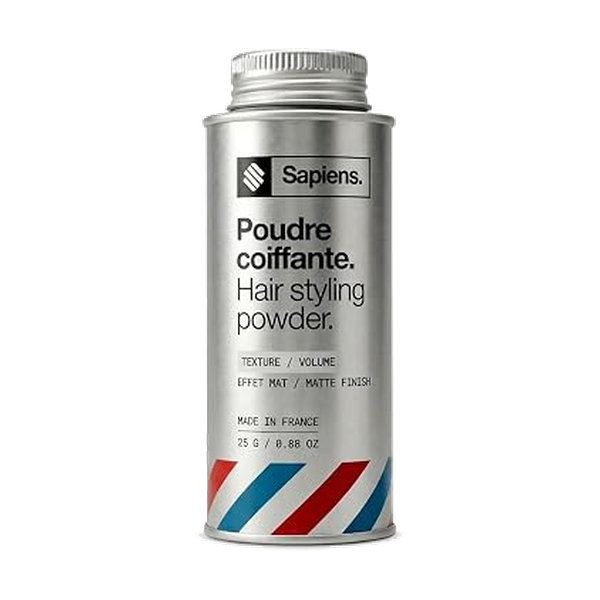
Styling powder 25 g — Sapiens
Start from the result you want to obtain
Before taking a product, choose what needs to change: take off the roots, bring the bangs forward, mark a part or define the waves. Also observe the sides and back with a second mirror. A hairstyle can look good from the front and leave a flattened area at the top or a strand sticking out behind an ear.
Start with your fingers and, if necessary, a comb or brush suitable for your hair. The comb helps to draw a parting and obtain regular lines; the fingers allow you to keep a less uniform movement. Then choose a single product to test its effect. You can add a step if you identify a specific need.
Prepare hair without mishandling it
After washing, press the hair in a towel instead of rubbing it. To get back into shape between two shampoos, moistening the strands concerned may be enough: you do not need to re-wash the entire head. If the hair is already loaded with product and sticky, it is better to start again after a suitable washing than to add another layer.
Detangle without pulling, moving from the ends towards the roots when there are knots. Curly or frizzy hair is more easily detangled when wet with appropriate care, using your fingers or a wide-toothed comb. On straight hair, let it dry a little before handling it for a long time: wet, it is more vulnerable to breakage.
Create direction and volume when drying
To raise the top, lift the roots with your fingers or a brush, then accompany this movement with your breath. For bangs, work forward from the start; for a part, place the parting while the hair is still damp. The finishing product will then have less work to do to maintain an already installed shape.
Keep the hair dryer moving, away from the strands, with low or moderate heat. The scalp should not heat up unpleasantly. A concentrator tip helps direct the air, without having to stick it to the hair. You can also do without heat if your cut sits well when drying naturally; the hairdryer is a tool, not a necessity.
Choose a texture rather than accumulating pots
For a matte finish with parted strands, try a small amount of styling paste or clay. For a comb-over and shinier hairstyle, a pomade may work better. A wax often helps reshape the strands, while a gel can give a more rigid hold. These names remain benchmarks: two products from the same family can behave very differently.
A mousse can help prepare volume before drying; a light cream is more suitable for control and movement. A salt spray provides a textured feel, but may not be pleasant on hair that is already dry. Read the instructions to find out if the product is applied to damp or dry hair, then judge especially the hold and feel obtained on you.
Use powder for matte volume
The Sapiens powder recommended here is used on dry hair to add volume and texture. Place very little in the areas to be lifted, then distribute with your fingers. Start locally rather than sprinkling the whole head: you will see better if a second small quantity is useful. Avoid putting it in a cloud near your face or inhaling it.
This finish is especially suitable if you are looking for relief without shine. It does not replace a cream for curls that lack flexibility, nor a product intended for flat hairstyles. If the feel becomes rough or the strands become tangled, reduce the quantity or change the texture.
Apply the finish and preserve the curls
With a paste or wax, distribute a small amount between the palms and fingers first, then work into the hair instead of putting all the product on the bangs. Finish by placing a few strands. If hair immediately falls out or looks greasy, try less product before looking for stronger hold.
For curls and waves, spread a suitable cream, mousse or gel on damp hair and shape their shape with your hands. Let them dry without handling them constantly, or use a diffuser with gentle blowing. Once hair is dry, avoid brushing if you want to maintain grouped curls rather than more diffuse volume.
Adjust one item at a time
If the hairstyle does not hold, first identify what is giving way: still wet roots, too heavy product, too short strand or upset hair. On the next try, change just one setting. You'll understand what works quicker than replacing shampoo, styling, and your entire drying technique.
Avoid running a brush forcefully through an attachment that has become hard, and tightening the attachments to the point of pulling on the scalp. If you experience itching after a new product, stop using it and wash off the residue. Persistent irritation or an unusual fall deserves medical advice rather than another attempt to cover up.
Sources
Articles that may interest you
 Grooming
 Grooming
 Grooming
 Nutrition
About this content
The contents do not claim any medical or paramedical qualifications and are not systematically reviewed by a healthcare professional.
The site shares general information and practical tips. It does not make a diagnosis, does not prescribe any treatment and does not replace advice adapted to your situation.