
Miswak
How to use
Recommended product
To help you put this advice into practice, we select relevant products on Amazon, focusing on the best possible value for money. A targeted selection to save you time and make your choice easier.
These links are part of our affiliate partnership with Amazon: if you purchase something through them, we may earn a commission.
Miswak ×4 — ORINKO
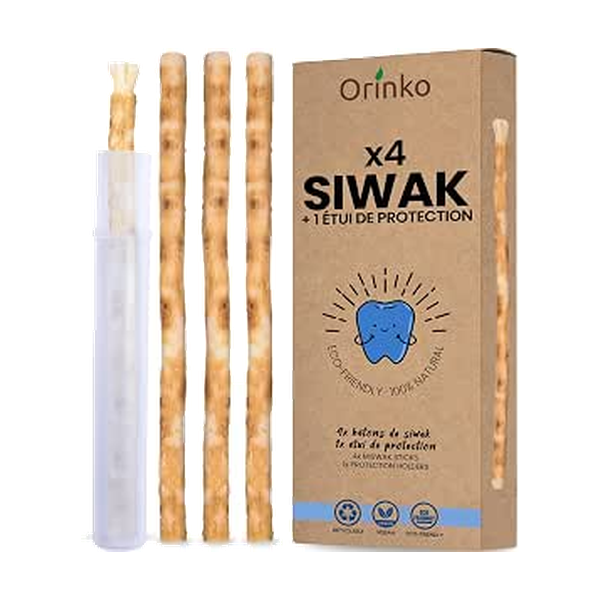
Choosing a stick intended for oral hygiene
Take a siwak identified as Salvadora persica, packaged for this use, and follow the seller's preparation and storage instructions. A branch found outside is not an equivalent. The ORINKO batch already associated with this sheet is kept for this additional use; the recommendation relates to the format of the product, without promising that one brand cleans better than another.
A stick that is easy to hold is better than a tiny piece that slips between your fingers. Maintain enough length to control the movement and reach the back teeth. Do not introduce a loose fragment into the mouth and avoid chewing the stick while walking or playing sports: it is used to clean, not to be kept between the teeth without attention.
Form a small soft brush
Wash your hands, then remove the bark from a short section at the end, about 1 cm, using a clean tool if needed. If dry, moisten it with drinking water and gently chew the end to separate the fibers. Aim for a small, soft brush; if the wood remains hard or splinters, do not force it against your teeth.
You don't need to turn the whole end into a big flared brush. A handy tuft allows you to work more precisely and access the internal surfaces. Remove any loose fibers rather than intentionally swallowing them. The herbal taste may be surprising at first, but a burning sensation or irritation is not something to look for.
Clean teeth without rubbing gums
Hold the stick to guide the fibers with light pressure. Work in small movements on the tooth surfaces, changing the orientation to reach the outer, inner and chewing surfaces. Take the time to go over the molars: cleaning limited to the incisors can give the impression of cleanliness while leaving many surfaces intact.
Avoid large, insistent horizontal frictions at the edge of the gums and do not try to push the wood under them. A dentist can show you a suitable procedure, especially if you already have exposed roots, sensitivity or an appliance. If the siwak hurts an area, discontinue its use there; pressing harder does not make cleaning more effective.
Use it at the right time in the routine
Siwak can be used for additional cleaning during the day, without adding toothpaste to the fibers. Keep your brush, manual or electric, with fluoridated toothpaste morning and evening. It is not necessary to add a passage of siwak just after each brushing: its practical benefit is above all to make possible a gesture that you would not have done otherwise.
Between the teeth, use floss or brushes adapted to the spaces, according to the advice of your dentist. The siwak tuft does not pass correctly through all contacts and does not replace these accessories. If you have to choose where to spend a few extra minutes, completing an absent interdental cleaning is generally more relevant than making multiple passes on the same front teeth.
Maintain fibers and storage
After use, rinse the tip with potable water, remove visible debris and allow it to dry in a clean place. For transport, protect it without permanently enclosing wet fibers in an airtight box. Do not share the stick. The storage conditions of the reserves may vary depending on the packaging: keep the manufacturer's instructions rather than leaving all the opened sticks together.
Cut the used part again when it becomes dirty, deformed or difficult to clean, then prepare a new end. Discard the stick if it shows mold or unusual deterioration. Its plant origin does not exempt it from hygiene. Bleeding that returns, receding gums or persistent pain calls for an examination, not more vigorous cleaning to try to resolve the problem.
Sources
- powo.science.kew.org · general-information (new tab)
- Comparative effect of chewing sticks and toothbrushing on plaque removal and gingival health (new tab)
- Home Oral Care (new tab)
- Clinical benefits and adverse effects of siwak (S. persica) use on periodontal health: a scoping review of literature (new tab)
- The relationship between chewing sticks (Miswak) and periodontal health. 3. Relationship to gingival recession (new tab)
Articles that may interest you
 Grooming

 GroomingGroomingGrooming
About this content
The contents do not claim any medical or paramedical qualifications and are not systematically reviewed by a healthcare professional.
The site shares general information and practical tips. It does not make a diagnosis, does not prescribe any treatment and does not replace advice adapted to your situation.