
Protein
How to use
Recommended product
To help you put this advice into practice, we select relevant products on Amazon, focusing on the best possible value for money. A targeted selection to save you time and make your choice easier.
These links are part of our affiliate partnership with Amazon: if you purchase something through them, we may earn a commission.
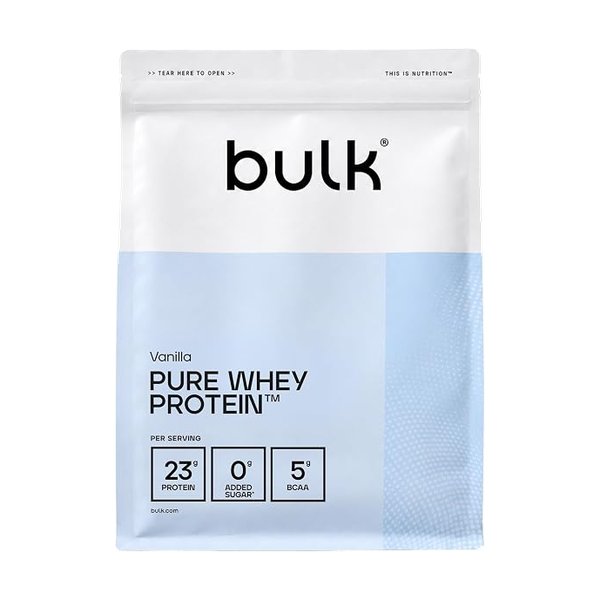
Whey protein 1 kg — Bulk
Identify your intake before adding a powder
For a few usual days, note protein sources and their portions from labels or a food composition table. Count your whole day's protein, not just meat and shakes. The weight of the food is not its weight of protein: a 150 g serving of fish does not provide 150 g of protein, and 30 g of powder does not necessarily correspond to 30 g of protein.
For an 80 kg person aiming for around 130 g per day, a possible distribution would be 30 g for breakfast, 35 g for lunch, 25 g for a snack and 40 g for dinner. This example gives one organization, not four mandatory quotas. If three meals are enough, the snack is optional. Check your portions once to find your bearings, then avoid turning each meal into a constant calculation.
Animal sources in meals
Poultry, fish and eggs can fit into a main meal: an omelette with vegetables and bread, fish with rice, or chicken in a pasta dish. Vary your protein sources across the week, including plant-based options, rather than relying on a large daily portion of meat. Keep processed meat occasional and choose a pattern suited to your health needs and locally available foods.
Milk, yogurt, cottage cheese and skyr are practical for breakfast or as a snack. Their contents vary: compare the proteins per actual serving, not just the word “protein” on the package. Cheese also contributes to intake, but its energy and salt can make large portions less fit for purpose. Foods provide other nutrients; choose them for the whole meal and not just for their protein number.
Plant sources
Tofu, tempeh, soy foods, lentils, chickpeas and beans help build meat-free meals. For example, try tofu with rice and vegetables, or lentils with cereals. Dried vegetables also provide fiber and carbohydrates: their place on the plate is not reduced to a single category. The quantities required depend on the actual content of the product.
In a plant-based diet, vary the sources throughout the day to cover the different amino acids, without having to achieve a perfect combination in each bite. Grains and oilseeds contribute to the total, but a small handful of nuts doesn't automatically replace a serving of tofu or pulses. If achieving the goal requires volumes that are difficult to eat, a soy powder or vegetable blend can simplify the organization.
Whey: concentrate or isolate
Whey is a milk protein, also called whey protein. Concentrated whey is a simple choice if you tolerate it well. Isolate is more filtered, generally richer in protein and lower in lactose. It can be interesting depending on digestive tolerance, but is not automatically better for building muscle when the quantity of protein consumed is comparable. Check the composition rather than just choosing the name of the range.
If you are allergic to milk proteins, isolate does not solve the problem: less lactose does not mean absence of milk proteins. For lactose intolerance, tolerance depends on the product and the dose; a lactose-free label can help you choose. If a powder regularly causes digestive upset, change the formula or source rather than forcing yourself to take it.
Casein and other powders
Casein is another milk protein that is digested more slowly. It may be suitable if you enjoy a thick preparation or evening snack, but it is not essential before bed. Soy and plant-based blends, for example pea and rice, offer dairy-free options. Egg white powder is another possibility, to be chosen according to allergies, taste, tolerance and price.
Hydrolyzed whey or “clear” versions are not necessary to obtain good results: they can above all respond to a texture or drink preference. collagen is not a good primary protein for muscle building, and BCAAs alone are not a substitute for a complete intake. Sufficient nutrition and a simple powder if necessary come before the accumulation of several supplements.
Prepare the quantity you need
Calculate the amount of protein provided by the portion indicated on your package. For example, a 75% protein powder provides 22.5g of protein in 30g of powder. The Impact Whey Myprotein associated with this sheet is mixed according to the instructions, generally with water or milk; values change depending on flavor and formula. Check the label on your bag, and also count the amount of milk used.
Take the shaker at a time when it fills a real gap: low-protein breakfast, practical snack or distant meal after a session. Immediate consumption upon leaving the room is not obligatory if a suitable meal is planned. Avoid automatically adding it to an already sufficient day; a powder also provides calories and does not replace vegetables, fiber, or a complete meal.
Make the routine easy to keep
Make a list of a few sources you like and that fit your budget, then check them before shopping. Associate the choice with a habitual gesture: when you plan a meal, also choose its protein source. Keep a simple solution for busy days, like eggs, tofu, cottage cheese or canned dried vegetables. The shaker can remain a backup solution rather than a daily obligation.
If you miss your goal one day, start again at subsequent meals without trying to catch up on everything at once. Look at what complicates the routine: lack of shopping, too light breakfast or skipped meals. Adjusting this point helps more than raising the target again. Keep your diet varied and sufficiently energetic for training; proteins should not take up all the space to the detriment of other foods.
Sources
- anses.fr · NUT-Ra-Proteines.pdf (new tab)
- International Society of Sports Nutrition Position Stand: protein and exercise (new tab)
- mangerbouger.fr · les-aliments-economiques (new tab)
- mangerbouger.fr · les-alternatives-a-la-viande-existent (new tab)
- What does it look like? | ASC (new tab)
- Dietary Supplements for Exercise and Athletic Performance - Health Professional Fact Sheet (new tab)
- Impact Whey Protein | Myprotein FR (new tab)
- The effect of protein timing on muscle strength and hypertrophy: a meta-analysis (new tab)
- Does it really take 66 days to form a habit? We asked the expert, Dr Pippa Lally | University of Surrey (new tab)
- Healthy diet (new tab)
Articles that may interest you
 Nutrition

 GroomingGroomingGrooming

About this content
The contents do not claim any medical or paramedical qualifications and are not systematically reviewed by a healthcare professional.
The site shares general information and practical tips. It does not make a diagnosis, does not prescribe any treatment and does not replace advice adapted to your situation.