
Sun protection
How to use
Recommended product
To help you put this advice into practice, we select relevant products on Amazon, focusing on the best possible value for money. A targeted selection to save you time and make your choice easier.
These links are part of our affiliate partnership with Amazon: if you purchase something through them, we may earn a commission.
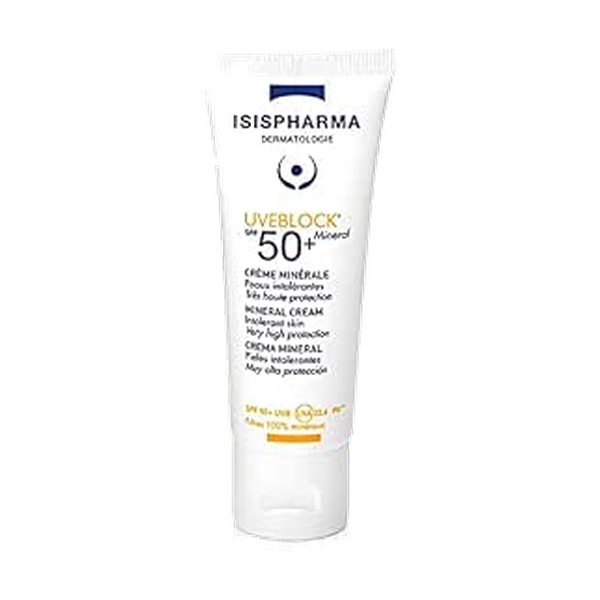
Sunscreen SPF 50+ 40 ml — ISISPHARMA
Choose a formula that you will want to wear
Choose SPF 30 or higher, protection against both UVA and UVB, and a texture that suits your skin. UVA labeling differs between markets: a circled UVA mark is used in Europe, while other products use locally defined broad-spectrum labeling. Check the protection claimed on the exact product. SPF 50 or 50+ does not compensate for missed areas or too little sunscreen.
For oily skin, look for a light texture that remains comfortable for several hours; for dry skin, a richer cream may be nice. You don't need to automatically choose mineral filters: tolerance depends on the entire formula. If a product stings, irritates, or makes you want to use less, try another formula rather than forcing yourself to finish it.
The product offered here, Uveblock SPF50+ Mineral, is a fragrance-free cream with mineral filters, designed for intolerant skin. This is a possibility if you are looking for this type of formula, with no guarantee that it will suit every skin. Check the reference received and its packaging: versions of the same range may have different textures and compositions.
Apply a real coat, without forgetting the contours
Distribute the sunscreen over all uncovered areas: face, ears, neck and, depending on your outfit, the back of the neck or décolleté. Marking two lines of cream on the fingers can help for the face, but remains approximate: the width of the tip, the texture and the surface to be covered change the quantity. Provide additional product for other areas and follow the manufacturer's instructions.
Spread evenly, taking time to work near the hairline and down the sides of the face. Apply before exposure: the brand of the recommended product indicates fifteen minutes. Avoid contact with eyes and wear protective glasses. In the sun, bald scalp and lips also require suitable protection, with a hat and sun balm.
Integrate it into the routine without multiplying layers
In the morning, apply your usual skincare products then sun protection, before applying any makeup. Let the layers settle to avoid moving the product. If your sunscreen moisturizes enough, you can simplify the routine underneath. Do not mix sunscreen with your serum or moisturizer in your hand: this changes the distribution of a formula intended to be used as is.
A foundation with SPF is not necessarily enough, because the quantity used for makeup is often too low to achieve the protection claimed. Keep dedicated protection if it allows you to apply enough. The vitamin C serum can complete your routine, but it does not replace UV filters and does not allow you to reduce their quantity.
Renew based on what you actually do
During prolonged outdoor exposure, reapply every two hours and after swimming, heavy sweating or wiping, even with a water-resistant formula. An application when you wake up does not automatically cover a lunch on the terrace then a long walk. Keeping the tube handy is often more useful than chasing an ever higher index.
The UV index helps to organize the day: the WHO recommends protecting yourself from 3. Also look at the time spent outside, the altitude and the reflection on snow or water. Cold and clouds alone do not provide information about UV rays. A whole day indoors, away from windows, does not require the same renewals as a hike; adapt your routine to actual exposure and any instructions from your dermatologist.
Also make room for shade
Use the local UV Index and weather forecast rather than a fixed timetable for one country. Take sun-protection measures when the UV Index is 3 or above and limit time in strong midday sun. Seek shade, wear a broad-brimmed hat and protective clothing, and apply sunscreen to uncovered skin. If you become sunburned, stop the exposure.
Store the tube according to the package directions, avoiding letting it cook in a car or in direct sunlight. Respect its expiry date and its duration of use after opening. If a reaction persists, change the product and seek advice. Certain treatments make the skin more sensitive to the sun: your pharmacist can check the precautions specific to the medications you are taking.
Sources
- How to apply sunscreen (new tab)
- Sunscreen FAQs (new tab)
- Dangers du soleil : comment s'en protéger ? (new tab)
- Radiation: The ultraviolet (UV) index (new tab)
- eur-lex.europa.eu · fra (new tab)
- Uveblock SPF50+ Mineral | Crème minérale très haute protection (new tab)
- Ultraviolet radiation (new tab)
- How to decode a sunscreen label (new tab)
Articles that may interest you
 Grooming

 GroomingGroomingGrooming
About this content
The contents do not claim any medical or paramedical qualifications and are not systematically reviewed by a healthcare professional.
The site shares general information and practical tips. It does not make a diagnosis, does not prescribe any treatment and does not replace advice adapted to your situation.