
Vitamin C for skin
How to use
Recommended product
To help you put this advice into practice, we select relevant products on Amazon, focusing on the best possible value for money. A targeted selection to save you time and make your choice easier.
These links are part of our affiliate partnership with Amazon: if you purchase something through them, we may earn a commission.
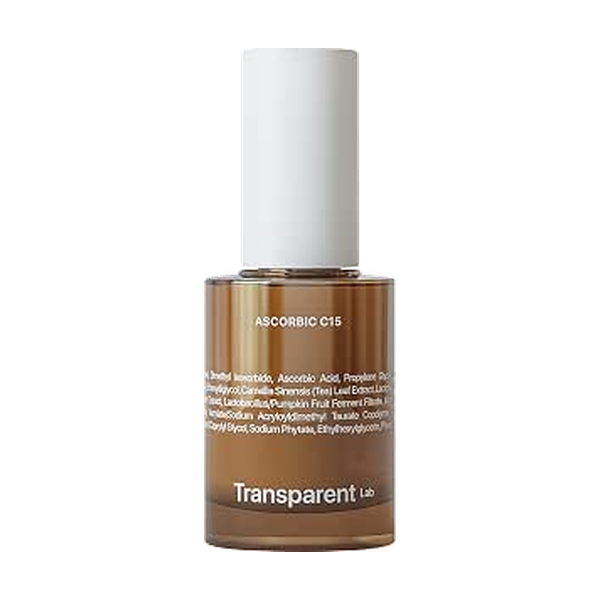
Vit. C serum 15% 30 ml — Transparent Lab
Choose the formula before the percentage
On a list of ingredients, “Ascorbic Acid” means pure vitamin C. It is a well-studied form, but difficult to stabilize and often offered in acid serums which can sting. Names like “3-O-Ethyl Ascorbic Acid” or “Ascorbyl Glucoside” designate derivatives, used in particular to facilitate formulation. Their tolerance and effectiveness depend on the finished product: a high percentage is not enough to decide between two bottles.
The Hummingbird Vitamin C15 Booster featured here contains 15% 3-O-Ethyl Ascorbic Acid, a stabilized derivative, in a fragrance-free formula. It is an option for a dull complexion or pigment irregularities, with a light texture. This 15% is not equivalent to 15% of pure L-ascorbic acid: studies carried out on the latter do not automatically evaluate this serum. Check the version and instructions for the product purchased, as several boosters exist in the range.
Integrate it into your routine
For this booster, the manufacturer recommends one or two pressures after cleansing, on the desired areas, then a moisturizer or sun protection. Start one to three times a week; the brand then plans to increase to four or five uses per week. Avoid the immediate eye area. With another serum, follow its own instructions rather than automatically repeating this quantity or rhythm.
Morning is a convenient time to take advantage of the antioxidant action during the day. Distribute the serum in a thin layer, let it settle, then continue your routine without mixing the products in your hand. An application in the evening remains possible if it better corresponds to your habits and the indications for the treatment.
Avoid asking too much of your skin
Introduce the serum at a time when your skin is comfortable, without adding several new active ingredients in the same week. If you also use retinol or an exfoliant, separate applications initially to make it easier to spot irritation. It is not a general ban on combining them: the difficulty comes mainly from the accumulation of irritating formulas and the sensitivity of your skin.
Tingling does not prove that the treatment is working better. If burning, persistent redness or patches appear, discontinue use and return to a gentle routine; seek advice if the reaction persists or is severe. Skin that does not tolerate pure vitamin C may prefer another formulation, but a derivative does not offer a guarantee of no reaction.
Store the serum and observe changes
Close the bottle carefully and store it away from sunlight and heat. Respect the duration of use after opening and the brand's storage instructions; the refrigerator is not a general obligation. A marked change in color, odor or texture merits checking with the manufacturer. The starting shade varies depending on the formula: a slightly yellow serum is not necessarily damaged.
To monitor the result, take a photo at the start and then compare it after several weeks, in similar light. Changes to spots and fine lines generally take longer than an immediate feeling of supple skin. If the result remains low despite regular use, increasing the concentration is not necessarily the answer. A spot that changes appearance or persistent pigmentation deserves a dermatological opinion rather than a succession of serums.
Sources
- Booster de vitamine C 15 » Pour une peau éclatante I colibri skincare (new tab)
- Stability, transdermal penetration, and cutaneous effects of ascorbic acid and its derivatives (new tab)
- Topical Vitamin C and the Skin: Mechanisms of Action and Clinical Applications (new tab)
- Efficacy of topical vitamin C in melasma and photoaging: A systematic review (new tab)
- Topical ascorbic acid on photoaged skin. Clinical, topographical and ultrastructural evaluation: double-blind study vs. placebo (new tab)
Articles that may interest you
 Grooming

 GroomingGroomingGrooming
About this content
The contents do not claim any medical or paramedical qualifications and are not systematically reviewed by a healthcare professional.
The site shares general information and practical tips. It does not make a diagnosis, does not prescribe any treatment and does not replace advice adapted to your situation.