
Masseter muscles
How to use
Recommended product
To help you put this advice into practice, we select relevant products on Amazon, focusing on the best possible value for money. A targeted selection to save you time and make your choice easier.
These links are part of our affiliate partnership with Amazon: if you purchase something through them, we may earn a commission.
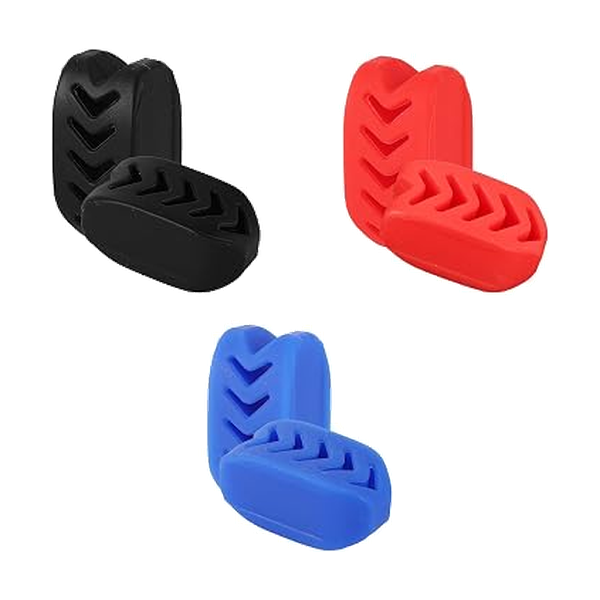
Jaw exercisers ×6 — SAVITA
Choose the change you're looking for
Look at your face at rest rather than while clenching your teeth. Do you really want more width on the sides, or are you mainly looking for a sharper contour? These objectives are not equivalent. Appearance also depends on bone structure and fatty tissue; developing muscle does not solve all the causes of a poorly defined lower face.
Understand what the hardware does
Ordinary chewing gum offers limited and variable resistance as you chew; it is not an easy progressive load to control to seek volume. Elastic blocks, like the device presented here, allow closing work against resistance. The practical interest is to be able to organize effort and progression, even if their aesthetic superiority remains insufficiently studied.
Adapt the use to your jaw
If you choose a device, check its positioning and instructions before using it. Maintain controlled movements and comfortable resistance, without chattering teeth or seeking maximum bite. As aesthetic progression is not well studied, there is no validated number of sets or repetitions to apply as a universal program.
Consider this practice as bodybuilding work: it requires real effort, regularity over time and recovery time. Choose slots that you can hold and note the resistance used, your comfort and the evolution. Avoid mechanically adding a session each day; an accumulation of requests does not guarantee better progress.
Keep your jaw relaxed between sessions
Gritting your teeth while working, commuting or in front of the mirror is not a useful routine to establish. Instead, use a daily cue to relax your jaw if you find yourself clenching it. A photo taken at rest, in comparable conditions, also provides a better basis for monitoring than an impression obtained by voluntarily contracting the muscles.
Consider comfort
If you experience pain, blockage, or difficulty opening your mouth, stop further straining and have the situation evaluated. A dental or joint problem already present deserves advice before the exercises. Recommendations for temporomandibular disorders particularly encourage reducing clenching and chewing gum when they contribute to symptoms.
Sources
- Effects of gum chewing training on occlusal force, masseter muscle thickness and mandibular shape: A randomised controlled clinical trial (new tab)
- TMD (Temporomandibular Disorders) (new tab)
- ncbi.nlm.nih.gov · NBK539869 (new tab)
- The Masseter Muscle and Its Role in Facial Contouring, Aging, and Quality of Life: A Literature Review (new tab)
Articles that may interest you
 Activity

 Activity

 GroomingGrooming
About this content
The contents do not claim any medical or paramedical qualifications and are not systematically reviewed by a healthcare professional.
The site shares general information and practical tips. It does not make a diagnosis, does not prescribe any treatment and does not replace advice adapted to your situation.