
Body cleansing
How to use
Recommended product
To help you put this advice into practice, we select relevant products on Amazon, focusing on the best possible value for money. A targeted selection to save you time and make your choice easier.
These links are part of our affiliate partnership with Amazon: if you purchase something through them, we may earn a commission.
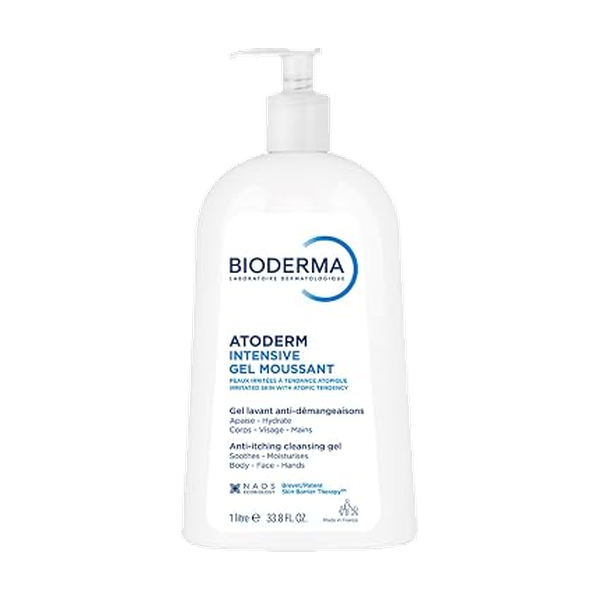
Body wash 1 L — Bioderma
Choose the cleaner
A gentle shower gel or soap-free cleansing bar is a good place to start, especially if your skin is dry. Choose a fragrance-free formula when you react easily to products.
The Sanex Zero% for sensitive skin already offered in this sheet remains an option for daily washing. The brand presents its current Sensitive formula as fragrance and soap free. Check the reference and the indications of the bottle received, because the range includes several versions.
Shower temperature and duration
Choose lukewarm water rather than very hot. For dry skin, five to ten minutes is a useful benchmark to avoid prolonging exposure to water.
Wash the body without rubbing
Hands are usually enough. If you prefer a glove, use it clean, without straining, then wash it and let it dry between uses. On spots on the back or shoulders, rubbing can especially add irritation.
Distribute the cleanser over damp skin with hands and sweep over armpits, neck, groin folds and buttocks. Also clean your back and areas covered in dirt or products. On very dry and lightly soiled arms or legs, it is not necessary to apply the product more often to obtain the sensation of degreased skin.
Feet deserve direct washing: simply letting the foam run over them does not always clean between the toes. Pass through accessible spaces, then rinse. Also think about the navel and folds of skin, without inserting a sharp object or scratching an irritated area to remove what seems to remain there.
Intimate cleansing concerns external surfaces. Avoid perfumed products on sensitive areas and do not put shower gel in the orifices. For the penis, lukewarm water is often enough; If the foreskin retracts easily, clean underneath, rinse, dry and put it back in place, without ever forcing.
For the vulva, a gentle external wash is sufficient; the inside of the vagina does not wash. An unusual odor accompanied by irritation cannot be resolved by multiplying the products or washings. If an area remains sore, red, or bothersome, have the cause investigated rather than treating it as just dirt.
Rinse, dry and moisturize
Rinse until all cleanser residue is removed, including under the arms and in the folds. Pat dry with a clean towel, taking time to dry between the toes and in areas that remain damp. On the rest of the body, avoid rubbing heavily to obtain perfectly dry skin.
If skin is dry, apply a cream or balm to affected areas after showering, while they are still damp. A so-called moisturizing shower gel does not always replace this treatment left on the skin. If you stay comfortable without cream, there is no need to add a step everywhere as a matter of principle.
Adapt the frequency of showers
After a session where you sweat a lot, take a shower and change out of damp clothes. If you have to wash a second time during the day, keep the action brief and target the product on the areas that need it. Skin that feels tight with each shower invites you to review the temperature, the cleanser and the quantity used.
A shower does not automatically require a shampoo or a second complete facial cleansing. Adapt these actions separately to your scalp and skin. The Facial cleansing sheet details washing the face, while Shampoo explains how to find the rhythm that suits the hair.
Sources
- Dermatologists' top tips for relieving dry skin (new tab)
- Dry skin - self-care: MedlinePlus Medical Encyclopedia (new tab)
- Body odour (new tab)
- devonsexualhealth.nhs.uk · genital-hygiene (new tab)
- Back acne: How to see clearer skin (new tab)
- How your workout can affect your skin (new tab)
- sanex.fr · zero-hypoallergenique-shower-gel (new tab)
Articles that may interest you
 Grooming
 Grooming
 Grooming
 Nutrition
About this content
The contents do not claim any medical or paramedical qualifications and are not systematically reviewed by a healthcare professional.
The site shares general information and practical tips. It does not make a diagnosis, does not prescribe any treatment and does not replace advice adapted to your situation.